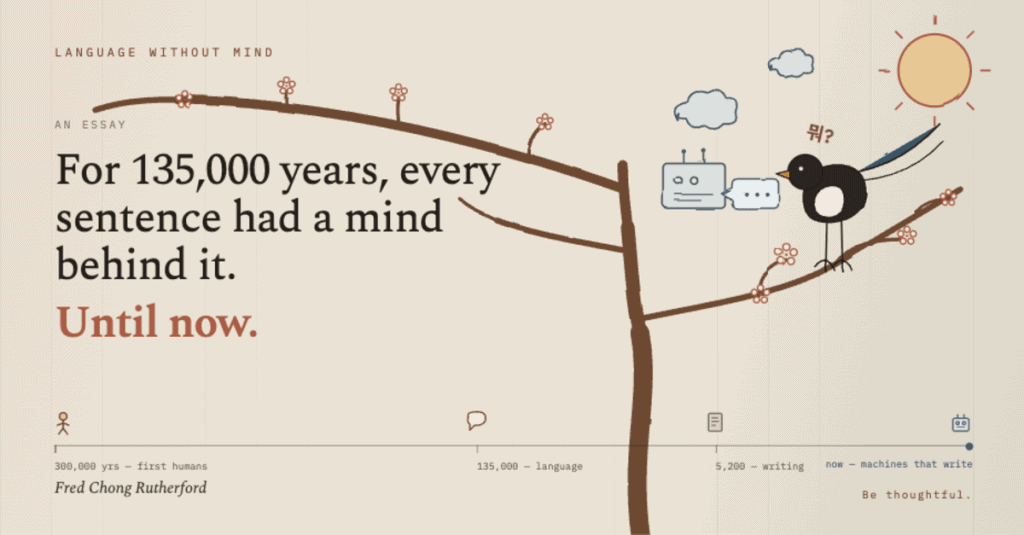
Humans have existed roughly 300,000 years, and we’ve had language for approximately 135,000 years. And we generally say that writing as langauge started with cuneiform script in Mesopotamia in 3200 CBE, which means humans have had language for roughly 45% of our existence, and only 1.7% of our existence has included written language.
And over the 135,000 year brief history of human language, one iron-clad rule has existed – there’s a person on the other side of the language.
Until now.
If we heard speech, if we read words, we knew intuitively, practically instinctively, that a person said them. In rare cases where someone didn’t acquire language, that person still eventually learned the fundamental truth of language – that it represented the thoughts of a person expressing them.
Which means a conscious, living entity, expressed the language. Even these words, for over 5,000 years, you could know reliably that these were written by a person.
Until now.
In our hyperspeed era of social media, compute technology, and data center cloud super computers, in less than 20 years, 0.014% of the total time we’ve had language, we’ve now invented machines that can produce writing and speech for us without a mind present. That has no representation of thought behind the words.
And this reality is bashing against 135,000 years of language cultural etiquete, and against specific genes like FOXP2 and NOVA1.
Life makes language. An iron clad rule.
Until now.
This is the fundamental problem we’ve created for ourselves. Our species has built a tool which generates words for us. And the story of humans and technology for the last two centuries has been variations of, “we built the tool before we understood the implications of its use.” That’s atomic reactors and computers and internal combustion engines, that’s the hyperspeed of human progress.
So, of course some people think that Claude and ChatGPT and all their imaginary friends are alive.
We invented written language at the same time we invented complex accounting, and eventually used writing to express story, which was the eventual perfection of oral language in humans.
A part of our species without expertise in language and culture invented boxes that produce the illusion of both on demand.
So of course we have AI psychosis. We’ve got 135,000 years of evolution telling us, “only living things speak.”
And that AI psychosis extends further than the people who think the bots are alive. It’s also present when we believe that a machine thinks, that it reasons, that the metaphors are reality. The only idea behind the machine is the conglomeration of multiple people mixed together – but ultinately synthesized without mind. As if a haiku was merely getting 17 syllables arranged properly.
This is what we’re grappling with – how do we understand the concept of language derived without mind? And then use the tools accordingly.
We’ve already got people who’ve seen what they call a lie – the promise of language is that it comes from a mind – but we’ve now got no-mind language – and that no-mind language is often presented as if it came from a mind. So, one lie, compounded on the fact that the machines invent facts and lie as a feature, not a bug, of how their systems work.
Some people now look like a hawk for those lies – and some of us are losing complete faith in all language, expressed as …
“that’s AI.” I.e., That’s a lie.
There’s a culture element to language. We invent idiom, meaning, form and convention as each of us uses, expressed and perfects language.
And so, let me get to the point.
You, reading this.
Yes, you.
You are alive at the most pivotal point of human history since the creation of language, not matched since the creation of cuneiform script.
You are helping define how our species will grapple with the language of the mindless machines. That doesn’t make AI the enemy. It doesn’t make it a friend, either. Because enemies and friends are constructs of mind. AI is the tool, but it’s a tool that’s closest historic precedents are 5,200 and 135,000 years old.
So, here’s my advice. Two words.
Be thoughtful.
—
Sources
- Homo sapiens ~300,000 years: Hublin et al., “New fossils from Jebel Irhoud, Morocco and the pan-African origin of Homo sapiens,” Nature 2017 — https://www.nature.com/articles/nature22336
- Language ~135,000 years: Miyagawa et al., 2025, summarized at MIT News — https://news.mit.edu/2025/when-did-human-language-emerge-0314
- Cuneiform ~3200 BCE: Britannica, “Cuneiform” — https://www.britannica.com/topic/cuneiform .
- Denise Schmandt-Besserat’s work on clay tokens and the administrative origin of cuneiform is the standard citation: overview at https://sites.utexas.edu/dsb/tokens/the-evolution-of-writing/
- FOXP2: Lai et al., “A forkhead-domain gene is mutated in a severe speech and language disorder,” Nature 2001 — https://www.nature.com/articles/35097076 .
- https://www.cell.com/cell/fulltext/S0092-8674(18)30816-3
- https://www.rockefeller.edu/news/37256-a-human-specific-genetic-change-may-explain-language/
- On the mechanism: Bender, Gebru et al., “On the Dangers of Stochastic Parrots,” FAccT 2021 — https://dl.acm.org/doi/10.1145/3442188.3445922 .
- On not over-attributing mind: Shanahan, “Talking About Large Language Models,” 2023 — https://arxiv.org/abs/2212.03551 .
- Bender & Koller, “Climbing towards NLU: On Meaning, Form, and Understanding,” ACL 2020 — https://aclanthology.org/2020.acl-main.463/
- “Survey of Hallucination in Natural Language Generation,” Ji et al., ACM Computing Surveys 2023 — https://dl.acm.org/doi/10.1145/3571730
- https://arxiv.org/abs/2401.11817
- https://arxiv.org/abs/2206.07682 , later contested by https://arxiv.org/abs/2304.15004). .
- Computer Power and Human Reason (1976), and https://en.wikipedia.org/wiki/ELIZA_effect
- Collingridge’s dilemma https://en.wikipedia.org/wiki/Collingridge_dilemma